Saturday, 17 November 2007

Factors to Consider when Choosing Labradoodle Dogs

Factors to Consider when Choosing
Labradoodle Dogs


The way towards a happy and long-lasting relationship with Labradoodle dogs starts in choosing for the right puppy. As a potential dog owner, you must be equipped with information on how to choose a puppy that's right for you and your family. Here are some factors to consider:

A Labradoodle dog is no different from any other dogs when it comes to the amount of care and attention needed. In that they need the same amount of commitment and time that a young child needs.

Having a child and a pup together under the same roof is something to be well taken care of. Constant supervision is required to prevent them from hurting each other. Though these dogs are known as friendly and loyal dogs, watching them closely prevents the occurrence of roughhousing, pulling, biting and other injuries.

Labradoodle dogs fall under the hunting dogs category though they were developed for companion purposes. They became popular in home life thus making them wonderful pets for families even to those with children.

One of the reasons why people prefer dog for a pet is because of the security it can give. Having a dog that barks when someone approaches the door is just like having a living home alarm system.

Labradoodle dogs are not only good companions but also good watchdogs. They are very easy to train being very intelligent, having the characteristics of both the Lab and the Poodle.

Dogs are also popular pets because they provide great companionship to there owners. They are naturally social in nature, and love to please and spend time with its owner. They shouldn't be kept out in the backyard all through out the day, especially the puppies for they need more supervision, more interaction and regular training to develop behaviors accepted in human world.

Since Labradoodle dogs need regular exercise, taking them out for long walks is one way of spending time with them.

Richard Cussons is great lover of dogs and you can find our more about Labradoodle dogs at Labradoodle Savvy.com.


Article Source: http://www.ArticleBiz.com

By: Richard Cussons

Check Your Dog Food Ingredients

Check Your Dog Food Ingredients

Dogs, especially puppies and miniatures, are so innocent of their surroundings that they'll try anything once, even if it's harmful. This morning, as I was spraying an organic insecticide made from flowers and my miniature schnauzer took a few licks to see what is was like - before I caught her. Just like snakes, dogs use their tongues to test the environment. This spray isn't that bad because it's natural. Still, even natural repellents are pretty hard on the kidneys.

Dogs will try anything, even more so than cats, which are the most finicky pets you could own. So when you are putting out the dog food, chances are, even if there is something bad in there, if it tastes good enough, they'll consume the whole bowl and look at you to see if more is coming. And by the way, make sure you're not over feeding your puppy. Don't feed your puppy scraps or your unfinished food. That's too much food for an animal that doesn't get out very much. They have nowhere to burn off the food and will get fat, quickly.

So if dogs can't tell you how their food tastes, or read the label to see if there is something in their food that might be hard on the kidneys or digestive tract; it is up to you, their owner, to carefully check what is in that dog food bag that sits in the corner. With the recent crises of the Chinese putting junk in mix, it is time for you to do some label investigation to make sure you are not slowly killing your dog with ingredients that still make it onto our shelves.

First, let's understand the economics behind the making of dog food. Dog food manufacturers are in business for one main reason - and it's not to make dog food! They're in business to make a profit. Dog food is only what gets them to profitability. Once you know this, believe that if they can save money on manufacturing and beat the competition, they will. They don't do this because they want to hurt your pet. They do this because if they don't - the way their business model works - they will lose money and sell less dog food.

Have you been to the dog food aisle lately? Some stores have two or three aisles. There is huge competition on price and ingredients. You'll find your normal dog food; names you've grown up with, and then you'll find newer, organic or special diet dog foods. So know that there is not a lot of concern going on for your dog - just marketing what may catch your fancy. But you need to be aware of what to look out for on those labels.

Since Fido will probably eat the same food day in and day out, it is important to look past the attractive labels and clever marketing. Current pet food regulation allows manufacturers to use ingredients you wouldn't feed your pet in you knew. Look for the word "by-products" on the label. This can mean feet, bones and intestines.

Because dog food manufacturers have to make sure the product won't spoil, typically 12 months, they include preservatives. Fats used in dog food would go rancid, so they use synthetic preservatives called butylated hydroxyanisole (BHA) and butylated hydroxytoluene (BHT), propyl gallate, propylene glycol which is also used as a less-toxic version of automotive antifreeze, and ethoxyquin. Look for these on the label. There is not much information documenting their toxicity, safety, interactions, or use in pet foods that may be eaten every day for the life of your dog. Propylene glycol was banned in cat food because it causes anemia in cats, yet it is still allowed in dog food.

These potentially cancer-causing agents such as BHA, BHT, and ethoxyquin are allowed at pretty low levels. Using these chemicals in dog foods has not been thoroughly studied, and long term build-up of these agents could be harmful. Because of the questionable data in the original study on its safety, ethoxyquin's manufacturer, Monsanto, was required to perform a new, more rigorous study in 1996. Monsanto didn't find significant toxicity associated with its own product, but in July 1997 the FDA's Center for Veterinary Medicine requested that manufacturers voluntarily reduce the maximum level for ethoxyquin by half, to 75 parts per million.

The ball is in the air on ethoxyquin. Some pet food critics believe that ethoxyquin is a major cause of disease, skin problems, and infertility in dogs, others claim it is the safest, strongest, most stable preservative we have for pet food. And ethoxyquin is approved for human foods, preserving spices such as cayenne and chili powder, at a level of 100 ppm - but it would be pretty hard for even the most hard-core spice lover to consume as much chili powder every day as a dog would eat dry food. Ethoxyquin has not been tested with cats. Still, it is commonly used in veterinary diets for both cats and dogs.

What is the answer? What I suggest is that you contact suppliers who make dog food in small batches and ship them to your door. These companies are few and far between, but they do exist and they have higher quality ingredients with none of the dangerous preservatives. I discuss this great detail on my website Three Best Dogs, and give you suggestions to try for your treasured pet.

Dave Jackson lives in south Florida with his miniature schnauzer. He has great tips on how to care and feed your dog on his website Three Best Dogs.

Article Source: http://www.ArticleBiz.com

By: Dave Jackson


Dog Training - Dog Diarrhea

Dog Training - Dog Diarrhea

Diarrhea can, and chances are will come to every dog you ever have in your lifetime and is a very common type of illness to have but in most cases is nothing serious and is not a cause to worry.
Lots of things can cause diarrhea in your dog and although on most cases the vet need not be contacted if it persists or becomes uncontrollable by your dog then it may need a better examination and diagnosis to prescribe the correct medicine.
Diarrhea is more common in puppies due to their immune system not being as strong as a dog's immune system yet but diarrhea in dogs is also very common. Situations which cause diarrhea can be anything from a change in surroundings, worms, or conccidia, to a virus or pest your dog has caught.
A change in diet or food may have triggered the illness and it should be looked into to stop it happening again, dogs are very vulnerable to changes and it can affect them in many ways. Being over excited or having stressful days along with other emotional changes may bring this problem.
It is always important to look after your dog well while they are suffering this illness, puppies and dogs will get dehydrated in these times and you need to make sure they have enough fluids to stop further illness.
While your dog has diarrhea they become weaker due to low body weight and not getting sufficient vitamins so their immune systems lower making it easier to catch other viruses and illnesses.
Keep a close eye on your dog when they have diarrhea and if you have fears of it being anything but a common diarrhea cause then seek a vet or professional for advice. There are plenty of advice leaflets and informational sheets around in pet shops and dog care specialist places, as long as you are aware of your dog's problem and are aware of these facts you should be in good shape.

John Williams website owner. For more information on dog behavior training visit the dog-behavior-training.co.uk website at this link...Dog Training.


Article Source: http://www.ArticleBiz.com

By: John Williams

Owning Jack Russell Dogs and Teaching Your Kids to be Responsible Dog Owners

Owning Jack Russell Dogs and Teaching Your Kids to be Responsible Dog Owners

With Jack Russell dogs, once you have your new puppy, the training process should be started immediately. Training a puppy can be a pleasant experience especially if the outcome is positive. And one way of achieving successful training result is to start early and remain consistent even year after year.

Prepare Ahead Of Time, Before Your Jack Russell’s Arrival

Training your Jack Russell dogs should involve everyone in the household, even the kids. Yes your kids! Their participation in training the puppy will benefit not just the puppy but also themselves as well. It will give you children not just the feeling of pride and value, but is also one way of teaching them about responsibilities and caring for others. Moreover, participation of your child in training process is one sure and fastest way for the two to establish a healthy friendship that could last a lifetime.

Get Your Child Involved Early

All Children, no matter how responsible they may be, should not be given the full responsibilities in taking care of and training your puppy. As a parent, it is still your responsibility to make sure that your pet and your child is well taken cared of. But there are lots of things your child can do to contribute in the success of training your Jack Russell.

The list below are some of the many things your child can do to participate in caring for your new puppy.

1. One of the easiest things your child can do is to let her pick out your puppy prior to its arrival. At home before you go to the store, create a checklist of the things that your puppy needs. Take her to the store and have her read the list and help pick out supplies. Ask for her suggestions on which color or shape to pick. This activity will put her in the mindset of sharing the responsibility of taking care of the new pup.

2. Another task your child can do is to help set up the puppy's new and comfortable living area. Let her put the dog toys, arrange cushion inside the crate and then place the food and water dish in its proper area.

3. And the most important thing your child can do to help is to give the new puppy lots of love and attention. But remember, this should be done under close supervision of an adult, especially during your Jack Russell dogs first few days home.

Richard Cussons is great lover of dogs and you can find our more about Jack Russell dogs at Jack Russell Savvy.com.

Article Source: http://www.ArticleBiz.com

By: Richard Cussons

Dog Training - Dogs on Bonfire Night

Dog Training - Dogs on Bonfire Night

This time of year can be a worrying and confusing one for your dog, occurrences like bonfire night don't happen very often and that's what makes it a lot scarier for your dog or puppy.
Dogs do not like unfamiliarity's and all the flashes and sudden bangs can make your dog extremely scared and afraid of what is happening. Unfortunately there have been many cases of dog deaths on bonfire night over the last ten years so it's a must to keep an eye on your dog at this time of the year and any other similar time such as New Years Eve.
Accidents and injuries happen on bonfire night because of dogs or puppies being loose outside and the unfamiliar sounds and flashes causing them to go into a panic and running away from home, running into roads, or getting stuck in tight spaces trying to hide from the noises.
Fortunately, there are rules and advice that can be followed to prevent times like these and keep your dog in safe hands. To begin you will need to stop your dog being out at night and keep them reassured indoors and away from their outdoor home if they have one. This should be done from one week before the event to one week after the event so no fireworks before or after will scare them into trouble.
Make sure all the doors are locked and shut, if your dog sees an opening they will go for it if they become scared. Try to make a small sheltered area for your dog where they feel protected and in control, and cuddles and calmly playing with your dog may help your dog be less nervous and take their mind off the situation.
If your dog does escape, be calm and positive with them wile trying to get them back inside as quickly as possible, if all these rules are followed then everything should go to plan and you will be able to relax on bonfire night and not have to worry about your pet.

John Williams website owner. For more information on dog behavior training visit the dog-behavior-training.co.uk website at this link...Dog Training.


Article Source: http://www.ArticleBiz.com

By: John Williams

Top Five Tips for a Healthy Dog

Top Five Tips for a Healthy Dog

Whether you've had your loyal companion by your side for quite some time already, you've just acquired a brand-new puppy or adult dog, or you're considering a canine chum for a permanent pet, you'll want to do whatever it takes to ensure your dog lives a long, happy, and healthy life.

This concept may seem a little too simple or obvious, but the truth is that many dog owners-to-be and even longtime dog owners aren't necessarily prepared for the work involved in properly caring for a pet. If you already have a dog, and have noticed lethargy, fatigue, a negative change in behavior, or overall poor health in your pooch, it's time to take matters into your own hands and learn how to turn your dog's health around. If you have yet to buy a dog, make sure that you understand what's involved in the proper care of a dog and that you're prepared to do so before you make that very important purchase. Don't just go and buy the first puppy you see because he's "cute."

Here are the top five tips for keeping your dog healthy and happy and living with you as long as possible (or at least as long as you want him around!):

First, give him fresh water daily. While most dog owners aren't ignorant to the point where they forget to "water" their dogs, many don't bother giving them fresh water on a daily basis. Your dog should have access to plenty of fresh water every single day. This means that you'll need to change his water bowl every evening (or morning), empty the water that wasn't consumed, and refill with clean water. You'll also need to clean out his water bowl regularly to prevent the growth of harmful bacteria.

Second, feed him. It's a mistake to actually think you can just buy any kind of dog food (particularly for the singular reason that it's "cheap") for your dog. There are many different types of dog food out there, based on weight, size, nutritional requirements, and special health concerns. Read the labels carefully before buying dog food for your dog. If you're not sure, talk to his veterinarian to find out which type of food is the best for your pet. Keep in mind that puppies have different nutritional requirements than adult dogs, regardless of their respective sizes. For example, don't assume that you can feed puppies of larger breeds the same food you would feed smaller adult breeds. Further, don't forget to follow the package's instructions as far as how much food and how often you should feed your dog. Consult your veterinarian for further guidance or clarification.

Next, play with him and take him for walks. Just because you're feeding and watering your dog doesn't mean that he's healthy. Dogs of all breeds and sizes require daily outdoor activity, exercise, and fresh air, or their quality of life essentially suffers, contributing to lethargy, poor health, poor appetite, weight gain, lean muscle loss, or even disease. Even "indoor" dogs aren't meant to be cooped up indoors all day long. Smart and health-conscious dog owners take their dogs for walks every day, even in the cold; this is also a great way for you to get some fresh air and exercise, too. You can also let your dog run free (without a leash) in your yard for a time, supervised or unsupervised. Do whatever you can to ensure your beloved pet receives the exercise and fresh air he needs every day.

Don't forget to give your dog his needed shots. Dogs, just like cats, other pets, and humans, require certain shots in order to stay healthy and prevent harmful diseases and viruses from entering their systems, affecting their overall health. You'll need your veterinarian to give your dog the necessary shots (it's certainly not something you can attempt yourself, even if you theoretically could get your hands on the right drugs and dosages) at the right times and in the right amounts.

Finally, ensure your dog has regular checkups with his veterinarian. If you don't have a vet for your dog, find a qualified and recommended one, and get your precious pet checked out as soon as possible. In addition to receiving his shots, your dog also requires regular checkups to make sure he is healthy and in good shape. A professional veterinarian will also check the health of your dog's teeth, eyes, coat, and paws, and be able to detect any sicknesses present and give you the correct medication for your dog.

If you love your pet dog, you should be willing to do whatever it takes to ensure his life with you is a long, happy, and healthy one; this involves following these top five tips. There are, of course, other things you can do to improve your dog's health and keep him content, but following this list of essentials is a great start to becoming a great dog owner.

Craig Elliott is a writer for VetRx Direct. VetRx Direct is a leading supplier of Pet Medicine


Article Source: http://www.ArticleBiz.com

By: Craig Elliott


Thursday, 4 October 2007

List of Dog breeds (Page 32)

Zapadno-Sibirskaia Laika /
West Siberian Laika


The West Siberian Laika- WSL- is a hunting breed developed by the indigenous people of Northern Ural and West Siberia. They used Laikas mostly for treeing squirrels and hunting small predators with valuable fur.

Image:West Siberian Laika - Chara Jr. FL USA - at work..JPG

Communism in Russia destroyed the traditional way of life of these people and brought them and their hunting dogs to the brink of extinction. Industrialization in Siberia introduced many new breeds of dogs to this region. Crossbreeding with them completely wiped out the last remains of pure bred indigenous Laikas. Many Russian hunters from big cities such as Sverdlovsk and Moscow were aware of this process. They tried to save the last exemplars of Laikas. The first attempts to establish the West Siberians as a modern hunting breed was made in the 1920s. Two types of dogs: the Mansi Laikas, which had light bones and a narrow elongated head; and the so called Hanti Laikas with a powerfully built body and a shorter head, lay the foundations for the new breed.


Image:West Siberian Laika - Mansi light type - Zarya FL USA..JPG

In the beginning of the 1930s and later the Russian government began to establish Kennels and Clubs concerning the preservation and repopulating of Laikas to their previous regions. In 1947 the West Siberian Laika was officially recognized as a new Russian breed.

Image:West Siberian Laika - Hanti type - Chara Jr. FL USA..JPG

Image:West Siberian Laika Chara Jr. FL USA -Hanti type of head.JPG

Originally, West Siberian Laikas were pro dogs for pro hunters. They can work as versatility dogs, but their strength is in their ability to specialize on one type of game only. Professional hunters want their dog to be focused on the game with the most valuable fur. Laikas working on sable and pine marten were, and still are, the most valuable. Such selection is fully understandable. In the nineteenth century the money from one silver-black sable pelt supported a family of four for a year. Because of this, the dogs that worked on every kind of game were killed or kept out of breeding. West Siberians are the last breed of hunting Laikas that still preserve this pro ability in their genes. This is what really differentiates them from other Hunting Laikas and makes them so unique. They are capable of specializing on one game only and master hunting it to perfection.Today, careful training is paramount for a WSL to perform at its best. Depending on how it is trained, a West Siberian Laika can hunt squirrels, pine marten, or sable; or big game such as moose, bear, or wild boar. Some hunters prefer training their West Siberians for birds, such as Capercaillies, pheasants, or waterfowl. Properly raised and trained West Siberians make a tight bond with their masters and never loose contact with them in the forest or in the field. It is like a Symbiotic team created for successful hunting. West Siberians are poor guardians at home or for domestic stock. On the other hand during hunting big and dangerous game they are capable of protecting their human partners to the bitter end.

Hot climate is a problem for West Siberians imported directly from North Eurasia. When a litter is born in the USA, the chances for adapting to local temperatures, even in Florida, are better. West Siberians are selected for hunting and they live for it. Permanently keeping Laikas at home, on a chain, or in a cage is extremely harmful for them. If you do not have time or a place where you can hunt regularly with your WS Laika, it is not a dog for you. Highly territorial and aggressive with other dogs, WS Laikas cannot be kept properly in huge kennels. Two of them (usually male and female partners) are a good combination for hunting and breeding. The best way of bonding with a WSL is to raise and train it alone in an environment free of other dogs. The introduction of this breed to the USA had a stormy beginning. Cheap crossbreeds named Laikoids were imported here, and kennels of "industrial" magnitude were established for making fast money.

Image:West Siberian Laika -Zarya - FL USA - Mansi type of head.JPG

The Russian Standards for West Siberian Laikas changed several times/1947-1966 -1979-etc./. Usually Males stand 19 to 20 inches at the withers, females 18 to 19 inches. Most of the modern dogs today are bigger and heavier than their original ancestors. Typical for all Laikas are, erect, triangular ears and a tail that is carried high curving over the back . The coat is a so called double type observed in wolves and most of the polar dogs.


Hair that is too long, too soft, curly or growing in all directions is a sure sign of mixed blood. Standard colors are gray, rusty, and white. The gray coat can vary from almost white to very dark. Brown or shades of browns are absolutely unacceptable. Many dogs imported from Asia /Kazachstan/ have such a fault as a result of crossbreeding with German Shepherds and other breeds. Black, or black and white WS Laikas, frequently appear in litters and are considered by old descrptions of indigenous Laikas as pure bred. This color is unwanted today, because of its associations with the other Russian Laika-the so called Russo Europeans-that have exactly the same color. The real difference between those two breeds is in the shape of the body and head and most of all in the character of the West Siberians.They are COOL! Pure bred West Siberians are not so nervous or easily excited as other breeds of Hunting Laikas. They display such a brave, cool, and calculating type of behavior even in the most dangerous situations. It comes as a package along with the ability to work on big game and to track very old, "cold" tracks. With the economical changes in Russia West Siberian Laikas lost their popularity there. Pro hunting is a dying profession and the new Russian Elite prefers "prestige" breeds of dogs imported from abroad. Luckily, American Hunters discovered the true potential of this breed and have recently imported some pure bred West Siberians to the US. Chances for this breed to prosper in America are good. More than 200 hunters in Alaska, Canada, and the Continental United States use this type of dogs today. They became an important - American part of the huge family of Hunting, Sledding, and Herding Laikas living for millennia in Northern Eurasia. Preserving them in their original state is very important. Laikas, along with domestic Reindeer, are the oldest breeds of our civilization. They helped humanity to survive in the ice age.Changes in the climate usually work in both directions. Who knows -- may be, we will need these breeds again in the future. West Siberian Laikas are a living monument to an ancient, very rich, and highly sophisticated indigenous culture. We must preserve this superior achievement of selection for our future generations.

Sources in Russian Language: Voilotchnikov, A.T. and Voilotchnikova, S.D. Hunting Laikas, . Moscow: Forest Industry Publishing House 1982. Voilotchnikov, A. T. and Voilotchnikova, S.D.Laikas and Hunting With Them . Moscow: Forest Industry Publishing House, 1972. Voilotchnikov, A. T. and Voilotchnikova, S.D. "Which breed of Laikas is the best?" Hunting and Hunting Industry, 1972: Issue 10. page 30-31. The authors are a Russian family recognized as the world's leading experts on West Siberian Laikas.

Sources in Bulgarian Language: Raytchev, Vasko. The Bulgarian Shepherd-Legend and Reality, Stara Zagora: Bioshield Publishing, 1992. (pg. 20-23)

Sources in English Language: Demidoff, L.B. How to Raise and Train a Siberian Husky. New York: 1964 Beregovoy, V. Hunting Laika Breeds of Russia. Crystal Dream Publishing, 2001 . Little, Clarence C. The Inheritance of Coat Color in Dogs. New York: 1971.

Thursday, 27 September 2007

List of Dog breeds (Page 31)

Yorkshire Terrier


The Yorkshire Terrier, (often called simply the Yorkie), is a breed of small dog in the toy category. The long-haired terrier is known for its playful demeanor and distinctive blue and tan coat. Yorkies can be very small, usually weighing not more than 7 pounds (3.18 kg); the standard of this breed does not mention the minimum weight accepted nor does it specify a height. Based on registrations of the American Kennel Club, Yorkshire Terriers became the second most popular dog breed in the United States in 2006, trailing only the Labrador Retriever.

Appearance

General

The Yorkshire Terrier breed standard specifies that the dog should have a compact, athletic build suitable for an active lifestyle; and hold itself in an upright, confident manner.The Yorkie has a free, jaunty gait, with both head and tail held high For Yorkies, toy stature does not necessarily mean frail or fragile.

Coat and color

Yorkshire Terriers are a long-haired breed with no undercoat, which means that they do not shed as much as their short haired friends. Rather, their hair is like human hair in that it grows continuously and falls out rarely (only when brushed or broken).Additionally, since Yorkies carry less dander on their coat, they generally do not have the unpleasant "wet dog" odor when wet, and they may not affect as many people who suffer from dog-related allergies.
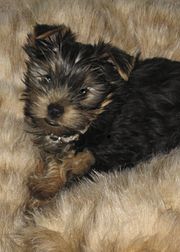
An AKC-registered Yorkshire Terrier puppy, aged 4 months, displaying the characteristic black and tan coat.

Yorkie puppies are born with a black and tan coat, and normally have black hairs mixed in with the tan until they are matured.The breed standard for adult Yorkies places prime importance on coat color, quality and texture. The hair must be glossy, fine and silky. However, some have very fine hair, making it feel a bit different and are harder to care for. From the back of the neck to the base of the tail, the coat should be a dark steel-blue (not silver-blue)- never mingled with fawn, bronze or black hairs.Hair on the tail should be a darker blue. On the head, chest and legs, hair should be a bright, rich tan, and darker at the roots than in the middle, shading to still lighter tan at the tips. Some Yorkies never turn the usual blond and continue to be gray. There should be no dark hairs intermingled with any of the tan in adult dogs.Many Yorkies do not conform to the standard for coat color; the tan may range from a very light blonde to a darker brown, while the body may be black or silvery gray.Many pet-quality Yorkies have "wooley" coats which are completely black across the back. The hair never "breaks" into the dark steel blue that is preferred in the breed because the coat texture is not a pure silk - the favorable coat texture. The Yorkie’s nose, lips, eye-rims, paw-pads and nails should be darkly pigmented.

The breed standard requires that the Yorkshire Terrier's hair be perfectly straight (not wavy). For show purposes, the coat is grown-out long and parted down the middle of the back, but may be trimmed to floor length to give ease of movement and a neater appearance. Hair on the feet and the tips of ears are also be trimmed.The traditional long coat is extremely high maintenance, requiring hours of daily brushing.To maintain the long coats of show dogs (between exhibitions), the hair may be wrapped in rice paper, tissue paper or plastic, after a light oiling with a coat oil made for show coats, which prevents the hairs from being broken easily and keeps the coat in condition.The oil has to be washed out once a week and the wraps must be fixed periodically during the week to prevent them from sliding down and breaking the hair. As a more practical alternative, many Yorkie-owners opt to keep the dog's coat trimmed to a shorter all-over length.

Build and proportions

The Yorkshire Terrier has a small head, which, according to the breed standard, should be rather flat and not too round.The teeth should have either a “scissors bite” or a “level bite” (no underbite or overbite).The Yorkie’s dark eyes are not too prominent, but should be sparkling, with sharp intelligent expression, and placed to look directly forward. The small, V-shaped ears are set high on the head, not too far apart, and should be carried In some kennel clubs, ears that do not stand up are cause for automatic disqualification.

Two AKC-registered Yorkshire Terrier puppies, Coco and Cougar. Ears vary between yorkies

The breed standard dictates that a Yorkshire Terrier must weigh no more than seven pounds.A Yorkishire Terrier of this weight is typically between 8 and 9 inches tall. There is no distinction made in the standard between Yorkies of various sizes (i.e. there is no "teacup" or "standard" within the breed standard). The compact body of a Yorkie is well proportioned with a level back that is the same height at the base of the neck than at the base of the tail.The tail is carried slightly higher than the level of the back.In a standing position, the Yorkie’s front legs should be straight. The back legs should be straight when viewed from behind, but moderately bent when viewed from the side.

Modifications

Often, a Yorkie’s dewclaws, if any, are removed. The AKC and UKC breed standards explicitly permit dewclaws to be removed, while the standards of other kennel clubs do not mention it.

Traditionally, the Yorkie’s tail is docked to a medium length. In America, almost all breeders dock the tails of puppies.However, since the 1990s there has been a growing movement to ban the practice of cosmetic docking. The World Small Animal Veterinary Association and the European Convention for the Protection of Pet Animals oppose tail docking. As of 2007, several nations have enacted prohibitions on docking, including Australia, Belgium, Cyprus, Finland, Germany, Greece, Luxembourg, Norway, South Africa, Sweden and Switzerland. A docked tail is part of the AKC, ANKC, CKC, NZKC and UKC breed standards for Yorkshire Terriers. The FCI and KC breed standards indicate the tail is customarily docked, but the KC standard gives specifications for an undocked tail (“as straight as possible; length to give a well balanced appearance”).

Temperament

Despite its Toy classification, the breed retains much lively terrier personality

Though a toy breed, the Yorkie still retains much of its terrier ancestry in terms of personality. Individual dogs will differ, but they are generally intelligent, independent and courageous. Yorkshire Terriers are quick to determine where they fit in a household's "pack." Their behavior towards outsiders will vary - they often will be inclined to bark at strangers, but some Yorkies are outgoing and friendly towards new people while others are withdrawn and aloof. The differences in behavior in this regard are largely based on how the owner trains or conditions (and socializes) the Yorkie. A few individual Yorkshire Terriers may be timid or nervous, rather than bold, but the vast majority do seem to meet the breed standard for a confident, vigorous and self-important personality. The following distinctive qualities are likely to be present in a Yorkshire Terrier:

Boldness

In a multi-breed home, many Yorkies will assert themselves as the "alpha" dog. Yorkies typically get along well with other dogs and love to play together with them. Rather, bold character comes from the Yorkie's mix of great inquisitiveness, or an instinct to protect, and self-confidence. Some Yorkies are unaware of their small size and may even challenge larger, tougher dogs. In one case a 12-pound Yorkie pushed open a screen door (to investigate a commotion outside) and rushed to the aid of an elderly woman who was being attacked by an 80-pound Akita. When the Yorkie snapped and growled, the Akita turned his attention on the small dog long enough for the woman to escape.Unfortunately, this boldness can get Yorkies into trouble, as small dogs can be seriously injured. For similar reasons, Yorkies do not make suitable pets for very young children.

Intelligence

Yorkshire Terriers as a breed are intelligent dogs. According to Dr. Stanley Coren, an expert on animal intelligence, the Yorkshire Terrier is an above average working dog, ranking 27th (32nd including ties) out of the 132 breeds tested. His research found that an average Yorkshire Terrier could understand a new command after approximately 15 repetitions and would obey a command the first time it was given 70% of the time or better. This capacity as working dogs enables Yorkies to excel in sports like obedience and agility, which require the dog to understand communication from the handler and carry out a complex series of commands. Additionally, Yorkies learn to recognize numerous words and can be taught to distinguish and fetch separate toys in a box by their names.

Independence

The well bred and well handled Yorkshire Terrier is content to be near its owner without being on a lap or underfoot.Yorkies are energetic, but also need much rest and will often prefer to spend downtime in privacy, such as in a kennel or out-of-the-way corner. Early terriers were expected to hunt in the company of handlers and other dogs, but also to have the self-confidence to go out on their own after prey. Very pampered and indulged Yorkies are more likely to be clingy and demanding, and lack the true terrier self-confidence. Yorkshire Terriers tend to be more difficult to train than some breeds, due to their characteristic independent nature. The independent mindedness of Yorkies leads some trainers to consider them to be among the hardest to house-break.

Health

A champion Yorkshire Terrier exhibiting the breed standard for color in a show-length coat.

Health issues often seen in the Yorkshire Terrier include bronchitis, lymphangiectasia, hepatic lipidosis, cataracts and keratitis sicca. Additionally, injection reactions (inflammation or hair loss at the site of an injection) are common.Yorkies often have a delicate digestive system, with vomiting or diarrhea resulting from consumption of foods outside of a regular diet. They are usually picky with which foods they eat. They usually will not eat what they don't like, it will be left aside. Trying to mix foods is not a good idea because they tend not to enjoy it.The relatively small size of the Yorkshire Terrier means that it usually has a poor tolerance for anesthesia. Additionally, a toy dog such as the Yorkie is more likely to be injured by falls, other dogs and owner clumsiness. Due to their small size, Yorkies may be endangered if kept in the house with an undiscerning or abusive person, especially a child. Many breeders and rescue organizations will not allow their Yorkies to go to families with young children, because of the risk it poses to the dog.

The life span of a healthy Yorkie is 12-15 years. Under-sized Yorkies (3 pounds or less) generally have a shorter life span, as they are especially prone to health problems such as chronic diarrhea and vomiting; are even more sensitive to anesthesia; and are more easily injured.

Hypoglycemia

Low blood sugar in puppies, or transient juvenile hypoglycemia, is caused by fasting (too much time between meals).In rare cases hypoglycemia may continue to be a problem in mature, usually very small, Yorkies. It is often seen in Yorkie puppies at 5 to 16 weeks of age.Very tiny Yorkie puppies are especially predisposed to hypoglycemia because a lack of muscle mass makes it difficult to store glucose and regulate blood sugar. Factors such as stress, fatigue, a cold environment, poor nutrition, and a change in diet or feeding schedule may bring on hypoglycemia. Low blood sugar can also be the result of a bacterial infection, parasite, or portosystemic liver shunt.Hypoglycemia causes the puppy to become drowsy, listless (glassy-eyed), shaky and uncoordinated, since the brain relies on sugar to function. Additionally, a hypoglycemic Yorkie may have a lower than normal body temperature and, in extreme cases, may have a seizure or go into a coma. A dog showing symptoms should be treated by a veterinarian immediately, as prolonged or recurring attacks of hypoglycemia can permanently damage the dog’s brain. In severe cases it can be fatal.

Genetic defects

As with many purebred dogs, the Yorkshire Terrier is prone to certain genetic disorders, including distichiasis, hydrocephalus, hypoplasia of dens, Legg-Perthes disease, patellar luxation, portosystemic shunt, retinal dysplasia, tracheal collapse and bladder stones.[27] The following are among the most common congenital defects that affect Yorkies.

  • Distichiae, eyelashes arising from an abnormal spot (usually the duct of the meibomian gland at the edge of the eyelid), are often found in Yorkies.Distichiae can irritate the eye and cause tearing, squinting, inflammation, and corneal abrasions or corneal ulcers and scarring. Treatment options may include manual removal, electrolysis or surgery.[28]
  • Hypoplasia of dens is a non-formation of the pivot point of the second cervical vertebra, which leads to spinal cord damage.Onset of the condition may occur at any age, producing signs ranging from neck pain to quadriplegia.
  • Legg-Perthes disease, which causes the top of the femur (thigh bone) to degenerate, occurs in Yorkies more than in any other breed. The condition appears to result from insufficient circulation to the area around the hip joint.As the blood supply is reduced, the bone in the head of the femur collapses and dies and the cartilage coating around it becomes cracked and deformed.Usually the disease appears when the Yorkie is young (between five and eight months of age); signs are pain, limping or lameness.The standard treatment is surgery to remove the affected part of the bone.Following surgery, muscles hold the femur in place and fibrous tissue forms in the area of removal to prevent bone rubbing on bone.Although the affected leg will be slightly shorter than prior to surgery, the Yorkie may regain almost normal use.
  • Luxating patellas (slipping kneecaps) are another common genetic defect in Yorkies. Weak ligaments and tendons in the knee or malformed (too shallow) patellar grooves, allow the patella to slip out of its groove sideways. This causes the leg to 'lock up' with the foot held off the ground.A dog with this problem may experience frequent pain and lameness or may be bothered by it only on occasion.Over time, the patellar ridges can become worn down, making the groove even more shallow and causing the dog to become increasingly lame.Surgery is the main treatment option available for luxating patellas, although it is not necessary for every dog with the condition.
  • Portosystemic shunt, a congenital malformation of the portal vein (which brings blood to the liver for cleansing), is also common in Yorkies. In this condition some of the dog's blood bypasses the liver and the “dirty” blood goes on to poison the heart, brain, lungs and other organs with toxins. A Yorkie with this condition might exhibit a wide variety of symptoms, such as small stature, poor appetite, weak muscle development, decreased ability to learn, inferior coordination, occasional vomiting and diarrhea, behavioral abnormalities, seizures (especially after a meal), blindness, coma and death.Often the shunt can be treated with surgery.
  • Tracheal collapse, caused by a progressive weakening of the walls of the trachea, occurs in many toy breeds, especially very tiny Yorkies.As a result of genetics, the walls of the trachea can be flaccid, a condition that becomes more severe with age.Cushing's disease, a disorder that causes production of excess steroid hormone by the adrenal glands, can also weaken cartilage and lead to tracheal collapse.There is a possibility that physical strain on the neck might cause or contribute to trachea collapse. Since this is usually caused by an energetic Yorkie pulling against his collar, many veterinarians recommend use of a harness for leashed walks.An occasional “goose honking” cough, especially on exertion or excitement, is usually the first sign of this condition.Over time, the cough may become almost constant in the Yorkie’s later life.Breathing through the obstruction of a collapsed (or partially collapsed) trachea for many years can result in complications, including chronic lung disease. The coughing can be countered with cough suppressants and bronchodilators.If the collapse is advanced and unresponsive to medication, sometimes surgery can repair the trachea.

History

Legacy

The Yorkie was bred as a ratter, used to kill mice and rats in small places.There is some evidence that they may have been used for hunting as well. Like most terriers developed in the early 19th Century, it was common for Yorkies to demonstrate their prowess as vermin killers in what were known as "rat pits." The terrier who killed the most rats in the least amount of time was considered the winner.

As a hunting group, terriers specialize in pursuing animals (usually vermin) that live in dens or burrows.Animals that are cornered and defending their young will fight ferociously. Therefore, any dog that would willingly pursue them must have an extraordinary degree of courage; terriers are bred for that quality.

Ancestry

As the name implies, the Yorkshire Terrier originated in Yorkshire (and the adjoining Lancashire), a rugged region in northern England.[35] In the mid-nineteenth century, at the peak of England’s industrial revolution, miners and mill workers from Scotland came to Yorkshire in search of work and brought with them several different varieties of small long-coated terriers, generally known as Broken Haired Scotch terriers (not Scotties). The specific breeds that make up the Yorkshire Terrier’s ancestry are not known, since the breeders at that time did not keep records of the bloodlines. Certain breeds, however, are commonly thought to be the main forebears. The likely source of the Yorkie’s small stature, long-haired coat and blue color are the Clydesdale, Paisley, Skye and Waterside terriers, all Scottish terriers transported to England at various times. The English Black and Tan Terrier bloodline probably gave the Yorkie its signature color pattern.These breeds were all working dogs, used to keep vermin under control in the textile mills and coal mines. Many have suggested that the Maltese, an ancient breed (likely originating in Asia), may be in the Yorkshire Terrier’s background as well.

The breed first appeared at an 1861 bench show in England as the Broken-Haired Scotch Terrier, named for the dog’s Scottish terrier ancestors.Early Yorkies were also known simply as Toy Terriers, in both rough and broken haired varieties.Yorkshire Terriers were given their breed name by 1874.

Huddersfield Ben

A dog known as Huddersfield Ben is universally acknowledged to be the foundation sire of the Yorkshire Terrier breed. He was born in 1865 in the town of Huddersfield, county of Yorkshire. The very public life of this dog, owned by M.A. Foster, did much to popularize the breed in England. Ben died in an accident at the age of six, but in his short life he won more than 70 prizes at dog shows and also demonstrated exceptional skill in ratting contests. Ben was a highly sought after stud dog because he was one of the first to consistently sire Yorkies true to type and under 5 pounds.

In America

The Yorkshire Terrier was introduced in the United States in 1872. The first Yorkie was registered with the American Kennel Club in 1878, making it one of the first twenty-five breeds to be approved for registration by the AKC. During the late Victorian era, the Yorkshire Terrier quickly became a popular pet, and as Americans embraced Victorian customs, so too did they embrace the Yorkshire Terrier. The breed’s popularity dipped in the 1940’s, when the percentage of small breed dogs registered fell to an all-time low of 18% of total registrations. Smoky, a Yorkie and famous war dog from World War II, is credited with beginning a renewal of interest in the then obscure Yorkshire Terrier breed. Boi, a yorkie owned by Kenny Ortega, played Sharpay Evan's puppy in the latest Disney movie, High School Musical 2.


Yugoslavian Mountain Hound /
Serbian Mountain Hound


The Serbian Mountain Hound is a rare dog breed from the Planina region of Serbia. Black and tan, smooth-coated, he is distinguished from the very similar Serbian Tricolour Hound by his lack of that breed's white front. He stands 18 to 22 inches (46-56 cm) high and weighs 44 to 55 pounds (20 to 25 kg). Like the Tricolour he is used to hunt fox, hare, and small game, occasionally hunting larger animals such as deer or even wild boar.

Perhaps the most memorable popular depiction of a Serbian Mountain Hound (then called Yugoslavian Mountain Hound) has been as the hand puppet "Triumph, the Insult Comic Dog," regularly appearing on the NBC television show Late Night with Conan O'Brien. Although the puppet displays physical characteristics of the breed, and was identified as such during many appearances, the caption identifying Triumph as a Yugoslavian Mountain Hound was promptly removed after NATO military action ensued against Yugoslavia, perhaps to avoid awkwardness during sequences in which Triumph ridiculed former Yugoslavian strongman Slobodan Milošević.

The breed was formerly known as the Yugoslavian Mountain Hound; the FCI changed the name in 1998.


Serbian Tricolour Hound

The Serbian Tricolour Hound is a very rare dog breed from Serbia. Black and tan with a white front (the white distinguishes him from the Serbian Mountain Hound, a similar breed), he stands 18 to 22 inches (46-56 cm) high and weighs 44 to 55 pounds (20 to 25 kg). Used to hunt fox, hare and other small game, occasionally hunting larger animals such as deer or even wild boar, the Serbian Tricolour is affectionate, gentle and a devoted hunter.

The breed was formerly known as the Yugoslavian Tricolour Hound; the name was changed by the FCI in 1996.